Augusta was founded in 1736 and was Georgia's capital 1785-1795. Its 46 National Register listings, museums with hours, and historic cemeteries.
Last checked Oct. 6, 2026. History comes from Augusta, Georgia Government’s history page and the city’s cemetery pages; National Register listings and dates from the National Park Service’s National Register spreadsheet, listings through May 22, 2026. Museum hours are as each museum publishes them.
Augusta was founded in 1736 by British Gen. James Oglethorpe and named for the bride of Frederick Louis, Prince of Wales, according to the city’s history page. The settlement was built on the slopes along the Savannah River in the area now called Summerville, land that was also home to Creek and Cherokee people. Augusta was a pivotal site in both the Revolutionary and Civil wars.
Who to call
- Augusta Museum of History: 706-722-8454, 560 Reynolds St.
- Boyhood Home of Woodrow Wilson: 419 7th St.; tours Wednesday through Saturday
- City cemeteries office (Magnolia, Cedar Grove, West View): 706-821-1746, 702 3rd St.
Key dates
| Year | What happened |
|---|---|
| 1736 | Augusta founded by James Oglethorpe |
| 1785 to 1795 | Augusta serves as Georgia’s state capital |
| 1818 | Magnolia Cemetery established as a public cemetery |
| 1820 | The city sets aside 40 acres for what became Cedar Grove Cemetery, a burial ground for enslaved African Americans |
| 1847 | The Augusta Canal is built; the city becomes the second-largest inland cotton market in the world |
| 1872 | The Cotton Exchange is established |
| 1996 | The City of Augusta consolidates with Richmond County to form Augusta-Richmond County |
Sources: the city’s history page and its pages on Magnolia and Cedar Grove cemeteries. The consolidated government has a mayor and 10 commissioners, and the city says it is one of only three consolidated governments in Georgia.
The historic downtown
Downtown Augusta is on the National Register as the Augusta Downtown Historic District, listed in 2004 and roughly bounded by 13th Street, Gordon Highway, Walton Way and the Savannah River. The older Broad Street Historic District (1980) covers Broad Street from 5th to 13th streets. The city says Augusta has nine neighborhoods on the National Register, and its landmarks include the Cotton Exchange, the boyhood home of President Woodrow Wilson, the Ezekiel Harris House of 1797, the home of George Walton, a signer of the Declaration of Independence, and Springfield Baptist Church, which the city calls the oldest African American church in America.
Museums and sites you can visit
| Place | Address | Hours as published |
|---|---|---|
| Augusta Museum of History | 560 Reynolds St. | Thursday to Saturday from 10 a.m.; Sunday 1 to 5 p.m.; closed Monday to Wednesday |
| Boyhood Home of Woodrow Wilson | 419 7th St. | Wednesday to Saturday, 10 a.m. to 4 p.m.; tours on the hour, closed noon to 1 p.m.; reservations encouraged |
| Morris Museum of Art | 1 Tenth St. | Free Sundays, noon to 5 p.m.; see the museum for other days |
| Augusta Canal Discovery Center | Enterprise Mill, 1450 Greene St. | Boat tours Tuesday to Saturday; see the canal for times |
| Magnolia Cemetery | 702 3rd St. | Cemetery office 7:30 a.m. to noon and 1 to 4 p.m. weekdays |
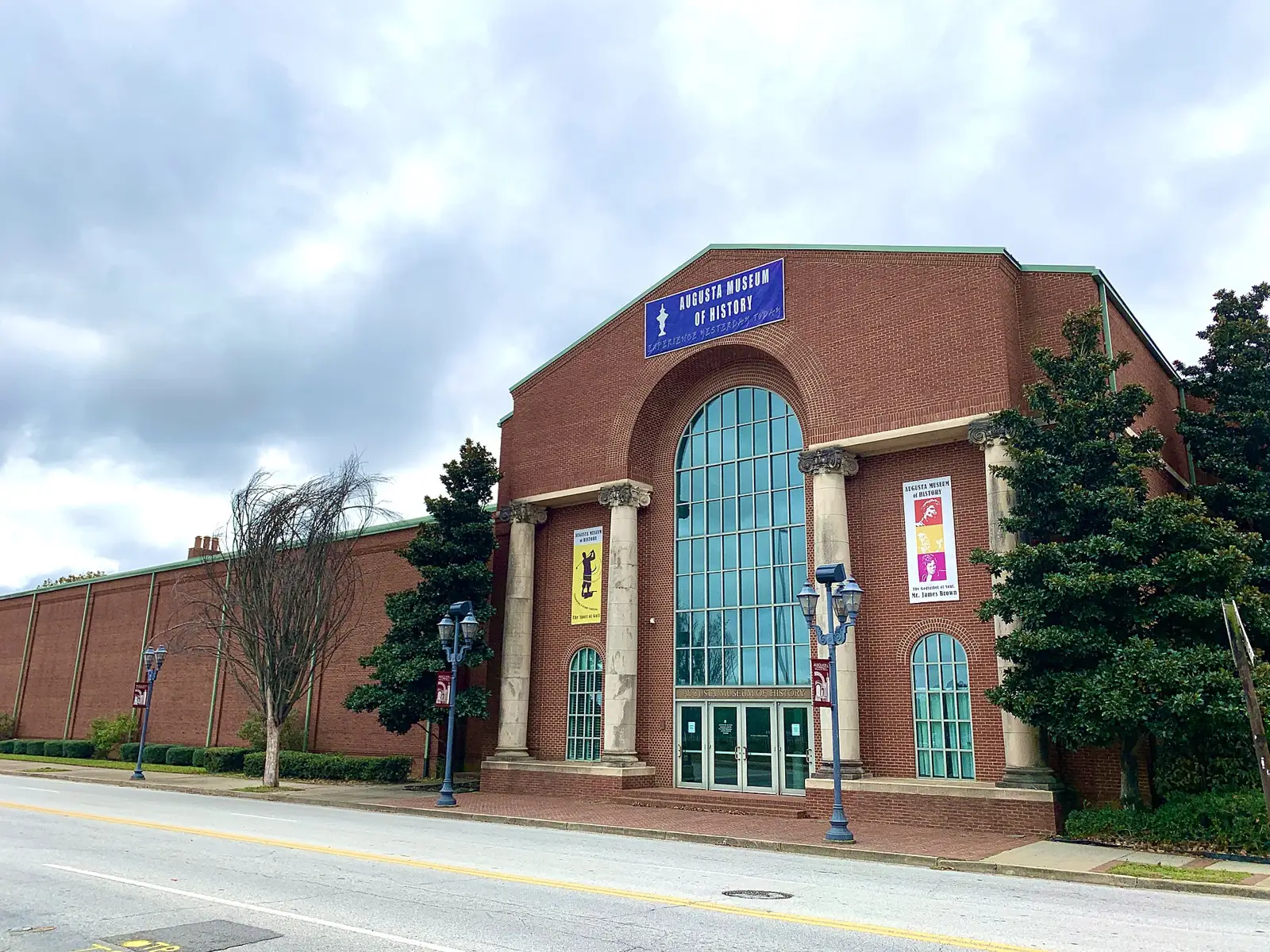
The Augusta Museum of History, founded in 1937, is the city’s oldest historical agency. Its permanent exhibition covers 12,000 years of local history, and it has galleries on golf and on James Brown. Admission is $7 for adults, $6 for seniors and $5 for ages 6 to 18; children under 6 and members are free.
Magnolia Cemetery, owned by the city since it opened, covers more than 60 acres with an estimated 34,000 burials, including seven Confederate generals and veterans of the American Revolution and the War of 1812, the city says. Cedar Grove Cemetery was the principal burial place for Black Augustans from the slavery era into the 20th century. Both are still active city cemeteries, along with West View.
Every National Register listing in Augusta
The National Park Service lists these 46 properties and districts in Augusta, with the year each was listed. Six are also National Historic Landmarks.
| Property | Address | Listed |
|---|---|---|
| Academy of Richmond County | 540 Telfair St. | 1973 |
| Academy of Richmond County-1926 Campus | 910 Russell St. | 2004 |
| Augusta Canal Industrial District | Along the west bank of the Savannah River from the Richmond-Columbia county line to 10th and Fenwick streets | 1971; National Historic Landmark 1977 |
| Augusta Cotton Exchange Building | Reynolds St. | 1978 |
| Augusta Downtown Historic District | Roughly bounded by 13th St., Gordon Highway, Walton Way and the Savannah River | 2004 |
| Augusta National Golf Club/Fruitlands | 2604 Washington Road | 1979 |
| Augusta Warehouse and Compress Company | 1812 Slaton Street | 2024 |
| Stephen Vincent Benet House | 2500 Walton Way | 1971; National Historic Landmark 1971 |
| Bethlehem Historic District | Roughly bounded by Wrightsboro Road, Martin Luther King Jr. Blvd., the railroad, Poplar, and Clay streets | 1997 |
| Brahe House | 456 Telfair St. | 1973 |
| Broad Street Historic District | Broad St. between 5th and 13th streets | 1980 |
| Cauley-Wheeler Memorial Building | 1339 Laney-Walker Blvd. | 2008 |
| Church of the Most Holy Trinity | 720 Telfair St. | 1997 |
| College Hill | 2116 Wrightsboro Road | 1971; National Historic Landmark 1971 |
| Engine Company Number One | 452 Ellis St. | 1988 |
| First Baptist Church of Augusta | Greene and 8th streets | 1972 |
| First Presbyterian Church of Augusta | 642 Telfair St. | 1997 |
| FitzSimons-Hampton House | State Route 28 | 1976 |
| Gertrude Herbert Art Institute | 506 Telfair St. | 1973 |
| Gould-Weed House | 828 Milledge Road | 1979 |
| Greene Street Historic District | Greene St. | 1980 |
| Harris-Pearson-Walker House | 1822 Broad St. | 1969 |
| Harrisburg-West End Historic District | Roughly bounded by 15th St., Walton Way, Heard Ave., Milledge Road, and the Augusta Canal | 1990 |
| Dr. Asbury and Martha Hull House | 2749 Hillcrest Ave. | 2018 |
| Lamar Building | 753 Broad St. | 1979 |
| Joseph Rucker Lamar Boyhood Home | 415 7th St. | 1996 |
| Laney-Walker North Historic District | Bounded by D’Antignac, 7th, Twiggs, Phillips and Harrison streets, Walton Way and Laney-Walker Blvd. | 1985 |
| Meadow Garden | 1230 Nelson St. | 1976; National Historic Landmark 1981 |
| Neuropsychiatric Infirmary Building 76 | 1798 Maryland Ave., Charlie Norwood VA Medical Center | 2020 |
| Neuropsychiatric Tuberculosis Ward-Building 7 | 1900 Maryland Ave., Charlie Norwood VA Medical Center | 2020 |
| Old Medical College Building | Telfair and 6th streets | 1972; National Historic Landmark 1996 |
| Old Richmond County Courthouse | 432 Telfair St. | 1978 |
| Paine College Historic District | 1235 15th St. | 2012 |
| Pinched Gut Historic District | Roughly bounded by Gordon Highway, E. Boundary, Reynolds and Gwinnett streets | 1980 |
| Reid-Jones-Carpenter House | 2249 Walton Way | 1979 |
| Sacred Heart Catholic Church | Greene and 13th streets | 1972 |
| Sands Hill Historic District | Roughly bounded by Monte Sano and North View avenues, Mount Auburn St., Johns Road, and Augusta Country Club | 1997 |
| Shiloh Orphanage | 1635 15th St. | 1996 |
| Springfield Baptist Church | 112 12th St. | 1982; boundary enlarged 1990 |
| St. Paul’s Episcopal Church | 6th and Reynolds streets | 1973 |
| Summerville Historic District | Roughly bounded by Milledge Lane, Wrightsboro Road, Highland and Heard avenues, Cumming and Henry streets | 1980 |
| Tubman High School | 1740 Walton Way | 1994 |
| United States Post Office and Courthouse | 500 E. Ford St. | 2000 |
| Weiss-Steinburg-Bush House | 1300 Buena Vista Road | 2019 |
| Woodrow Wilson Boyhood Home | 419 7th St. | 1979; National Historic Landmark 2008 |
| Woodlawn Historic District | Roughly bounded by Walton Way, Emmett St., Wrightsboro Road, and Heard Ave. | 2019 |
Source: National Park Service, National Register of Historic Places listed properties (spreadsheet), listings through May 22, 2026. Richmond County also has listings in Blythe and Hephzibah, not shown here.
What this means for you
- Start downtown, where the Augusta Museum of History, the Wilson boyhood home and the Telfair Street landmarks all are.
- Check hours before you go; several museums open only part of the week.
Related: parks and trails, things to do this month and Augusta population and growth.
Frequently asked questions
When was Augusta, Georgia founded?
In 1736, by British Gen. James Oglethorpe, according to the city. It was named for the bride of Frederick Louis, Prince of Wales.
Was Augusta ever the capital of Georgia?
Yes. Augusta was Georgia’s state capital from 1785 until 1795, according to the city’s history page.
How many National Register of Historic Places listings are in Augusta?
The National Park Service’s register lists 46 properties and districts in Augusta as of May 22, 2026, six of them also National Historic Landmarks.
When did Augusta and Richmond County consolidate?
In 1996 the City of Augusta consolidated with Richmond County to form Augusta-Richmond County, governed by a mayor and 10 commissioners.
What are the Augusta Museum of History’s hours?
Thursday through Saturday from 10 a.m. and Sunday 1 to 5 p.m.; closed Monday through Wednesday. It is at 560 Reynolds St.; phone 706-722-8454.
Have your say